35 Percent Increase in Both Arts and Sciences and Seas Student Enrollment Over the Past Decade
Dragana Borenovic Dilas, Credential Examiner at WES, Chris Mackie, Research Associate at WES, Ying Huang, Credential Examiner at WES, and Stefan Trines, Research Editor, WENR
This teaching profile describes recent trends in Indonesian education and student mobility and provides an overview of the structure of the education system of Republic of indonesia. It replaces an earlier version past Nick Clark.
Introduction
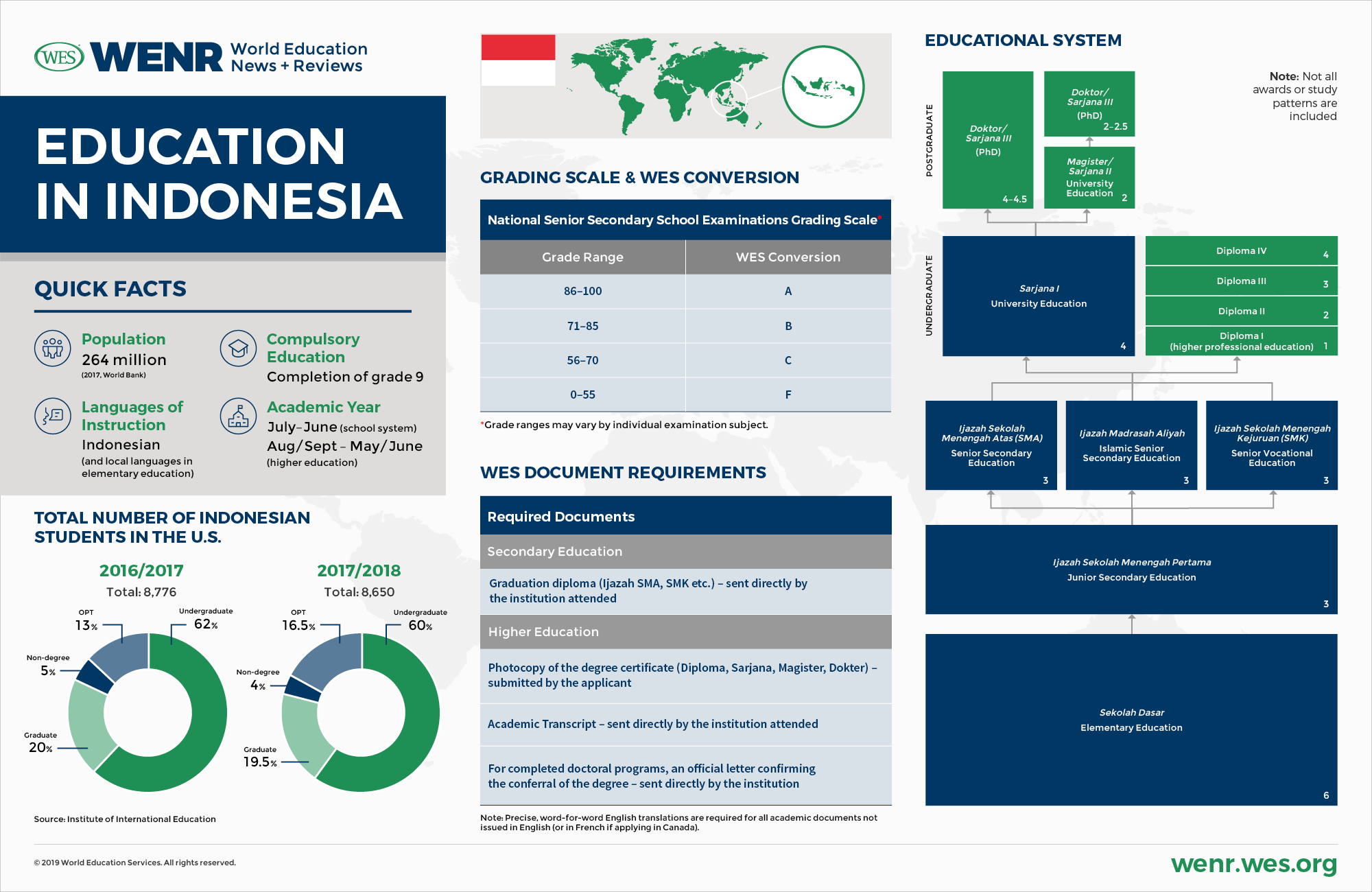
Indonesia, dwelling to 264 one thousand thousand people (2017, World Banking company), is the fourth most populous country in the globe. It is also the largest archipelago on the globe. Its territory spans more than 17,000 islands that stretch for iii,181 miles forth the equator between the Pacific and Indian Oceans.
Most 87 percent of Indonesia's population is Sunni Muslim, making Indonesia the largest majority Muslim country in the world. Simply the Southeast Asian country is simultaneously a diverse, complex, and multicultural nation of more than than 300 indigenous groups that speak hundreds of different languages. Some 10 percent of the population identify as Christians and almost one.7 percent every bit Hindus.
Indonesia's 3 largest ethnic groups are the Javanese (40.1 percent), primarily located on Java, the globe's most populated island and home to more than 50 percentage of the total Indonesian population; the Sundanese (15.5 percent); and the Malays (3.vii percent). Indonesia's cultural and regional diverseness is as vast as the number of its islands. Areas like rural Due west Timor or Indonesian Borneo (Kalimantan) are worlds apart from the flashy shopping malls of downtown Dki jakarta, Indonesia'south upper-case letter city of most ten one thousand thousand people.
Despite these marked differences, Indonesia is viewed as having a promising economic hereafter; information technology'southward bound to become a country of global importance in the 21st century. The island nation is currently transitioning from an agricultural economy driven by commodity exports to an economy based on industrial manufacturing and services. The professional person services business firm PricewaterhouseCoopers projects that Indonesia will abound into the world's fourth-largest economic system by 2050. This amazing economic ascension is partially based on demographic trends that will increase the country's population to most 321 million. Information technology's estimated that lxx pct of the population will exist working-age adults by 2030, a circumstance that volition supply the nation with a beneficial demographic structure and a voluminous labor pool.
Underscoring Republic of indonesia's tremendous economical potential, the land's center class is expected to double between 2013 and 2020. Meanwhile, urbanization is accelerating rapidly, and internet penetration rates have increased past more than 20 percentage between 2013 and 2016 alone. The percentage of people who take admission to electricity has jumped from 55 percent in 1993 to 98 percentage in 2016. Contempo economical growth rates have been relatively low compared with growth rates before the 1997 Asian financial crisis, but GDP has still increased steadily past more than 5 percent for most of the past eight years.
However, Indonesia is characterized not only past deep regional disparities, simply too by its condition as a developing state that is hard to govern and that remains marred past various socioeconomic bug. Information technology ranks 116th out of 189 on the Un's Human Development Index, and its Gdp per capita is less than half that of neighboring Malaysia. Xx-seven one thousand thousand Indonesians still alive on less than USD$0.75 a solar day. Life expectancy is seven years lower than in Vietnam.
To live up to its full economic potential, Indonesia needs to increase public spending, build upwards its infrastructure and bridge regional development gaps, curb corruption, provide stable and predictable governance, and enhance living standards by investing in health care, education, and human being capital letter development. As the World Bank'south Country Manager for Indonesia Rodrigo A. Chaves has noted, the "centre form holds the primal to unlocking the potential of Republic of indonesia. It is important for the government to back up the growth of this group in all fronts. This includes support to improve quality of education and skills of the population and promoting task-creating growth and aplenty access to social protection…."
Challenges in the Education System
As of now, Indonesia struggles to provide inclusive, high-quality education to its citizens. The state has much lower literacy levels than those of other Southeast Asian nations. An assay by the World Bank showed that 55 percent of Indonesians who complete schoolhouse are functionally illiterateane compared with simply 14 percent in Vietnam and 20 pct in member countries of the Organisation for Economic Cooperation and Evolution.
Tertiary attainment levels, too, are very low: The per centum of Indonesians over the age of 25 that had attained at to the lowest degree a bachelor's caste in 2016 was just under ix percent, the lowest of all the fellow member states of the Association of southeast asian nations (ASEAN). At that place may not be much incentive to obtain a tertiary degree—unemployment rates are highest amongst university-educated Indonesians. The research output of Indonesian universities is growing chop-chop, only it'southward still low compared with that of other emerging economies.
On the plus side, mean years of schooling among the population to a higher place the age of 25 accept doubled since the 1980s to 8 years in 2016. The pupil-to-teacher ratio has dropped from 20 to 1 to 16 to 1 in unproblematic educational activity between 2004 and 2017, fifty-fifty though this ratio has remained flat if not decreased at higher levels of schooling (every bit per data from the UNESCO Plant of Statistics – UIS). The third gross enrollment ratio (GER) leaped past 20 percent between 2004 and 2017, despite being still low overall. It now stands at 36.3 percent, compared with 28.iii percent in Vietnam, 42 percent in Malaysia, and 49.3 per centum in Thailand (UIS).
Since the mid-2000s, Republic of indonesia has implemented a broad range of teaching reforms, including the decentralization of parts of its school system, improvements in teacher training standards, and sizable increases in instruction spending (as a share of the national budget). Nonetheless, public educational activity spending as a percentage of Gdp has stagnated over the past decade and remains well below recommended levels for emerging economies (at 3.6 per centum of Gdp in 2015). More substantial efforts volition be required to overcome structural weaknesses in Indonesia'south system and bring information technology up to the standards of other fast-developing countries in the dynamic ASEAN region.
Outbound Student Mobility
Outbound student flows from Indonesia are growing, but they are still relatively modest. Despite being the world's fourth-largest country in terms of population, Indonesia was merely the 22nd-largest sender of international students worldwide in 2017, making up less than one percent of the more than 5 meg students studying abroad that year. Co-ordinate to UIS data, the number of Indonesian caste-seeking students enrolled overseas has grown by almost 62 percent since 1998, reaching a high of 47,317 in 2016. This growth made Republic of indonesia the tertiary-largest sender of international students amid Asean fellow member states in 2017, behind only Vietnam (82,160) and Malaysia (64,187).
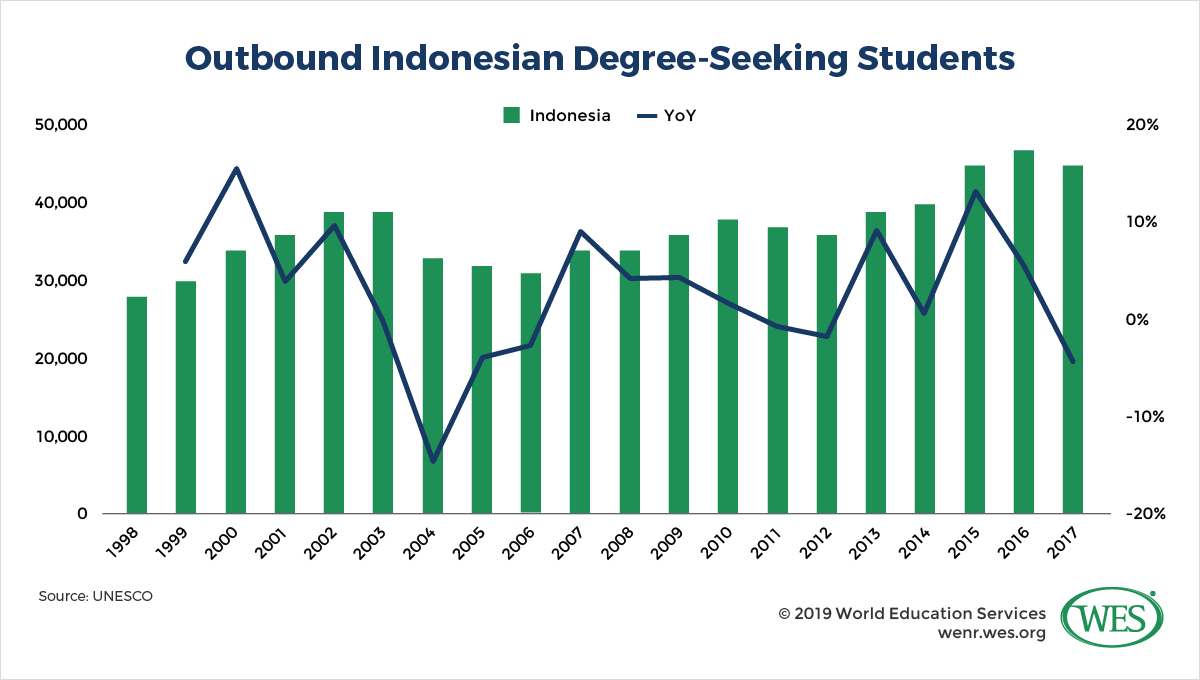
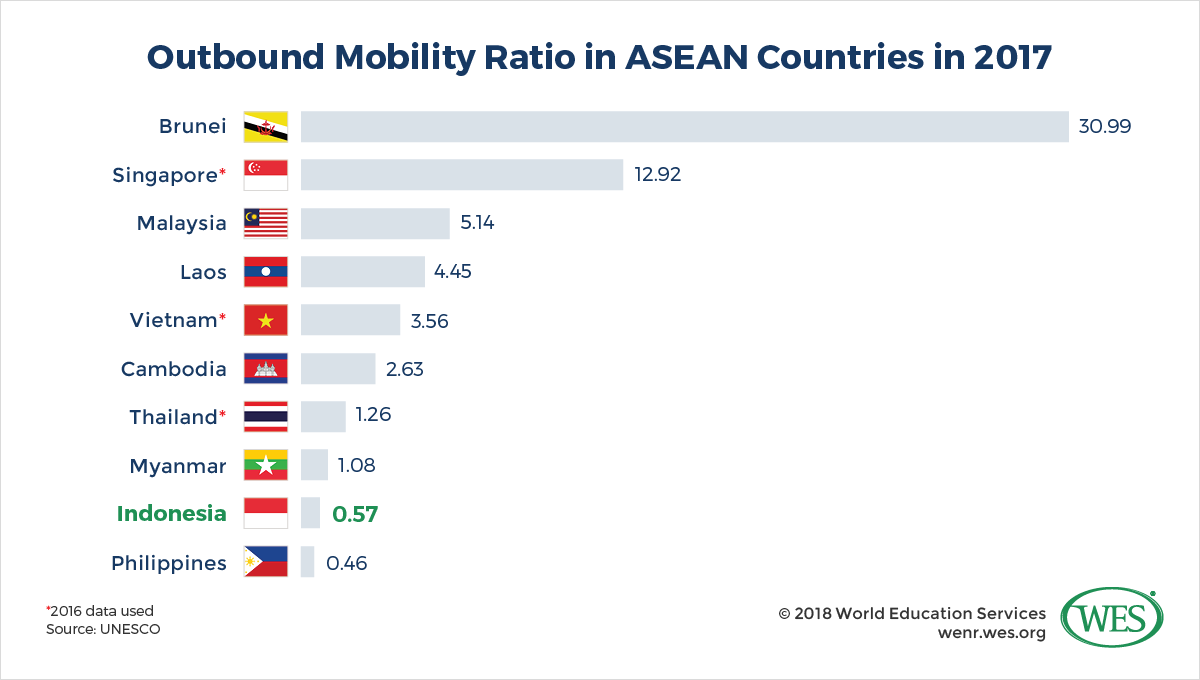
Still, Indonesian growth rates are dwarfed by those of smaller regional neighbors similar Vietnam, where outbound pupil numbers mushroomed past nearly 960 per centum between 1998 and 2017. Indonesia's outbound mobility ratio is small—only a tiny fraction of the country's students are currently heading overseas. While Vietnam and Malaysia, the two largest senders in the Association of southeast asian nations, have outbound mobility ratios of iii.56 and five.fourteen pct, just 0.57 per centum of Indonesia's third students are studying abroad, the second-lowest percentage among all Asean member states after the Philippines. This discrepancy is even more pronounced in the case of smaller countries like Singapore and Negara brunei darussalam, which have heaven-high outbound mobility ratios of 12.92 and 30.99 percent respectively.
Prospects for the Future
Even though outbound pupil flows are soon small, demographic and socioeconomic factors suggest that Indonesia volition play a major office in international education in the years to come up. Not only does Indonesia have by far the largest student age population in the ASEAN, it also has the 3rd-largest population under the age of 25 in the entire world: More than than 117 meg in 2017, post-obit but Bharat (616,550,830) and China (417,665,920).2 Consider that more than 40 percent of Republic of indonesia's population is nether the historic period of 25, with approximately 27 percent nether the age of 15; the median age is approximately 30.5 years. This large academy-age population means that Indonesia has a substantial pool of potential international students.
This is especially and so, given the expected rise of dispensable incomes in Republic of indonesia. The McKinsey Global Institute projected in 2012 that Indonesia'south "consuming class"three will abound "stronger than in any economy of the earth apart from Communist china and India," and will triple from 45 one thousand thousand to 135 million people by 2030. Need for college education will also be driven by the fact that there is a severe skilled labor shortage in Indonesia. A 2014 World Bank Policy Brief establish that despite a doubling of the number of workers who have at to the lowest degree some 3rd education between 2000 and 2010, still only 8 percent of workers possessed a tertiary degree, far brusk of the 21 percent demanded past the labor market. This unfulfilled need is likely to yield increases in tertiary enrollment rates in the long term, current unemployment rates among academy graduates notwithstanding. Already, between 2006 and 2016, total enrollment grew by 68 percentage, from nearly 3.7 million to more than 6.1 one thousand thousand.
A compounding factor is that rising demand for quality higher education is presently non met past supply in Republic of indonesia, and that current curricula are sick-suited for the labor market. The vast majority of Indonesian college education institutions (HEIs) are smaller private providers of lesser quality, while admission into public universities is highly competitive. Already in 2010, public universities had capacity for merely 18 percent of Indonesia's swelling number of loftier schoolhouse graduates. In light of such bottlenecks and quality shortcomings, growing numbers of students from center-income households will look overseas to obtain their degree. In fact, a recent survey conducted by AFS Intercultural Programs found that 81 percent of 13- to xviii-year-olds in Indonesia had considered study abroad.
Outbound mobility is also bound to exist additional by growing intraregional initiatives and scholarship programs designed to facilitate academic exchange and labor mobility, such equally the ASEAN Qualifications Reference Framework (AQRF) or the ASEAN International Mobility for Students (AIMS) plan. AIMS supports study abroad for one semester at participating institutions in the ASEAN. While the program is still small, with fewer than 1,000 students participating in 2016, numbers take increased steadily since its launch in 2010. Meanwhile, funding for the Indonesia Endowment Fund for Instruction, a governmental scholarship plan for graduate students studying both domestically and abroad, has more than than doubled between 2016 and 2017, from USD$105 million to USD$225 one thousand thousand. Given the high costs of studying abroad, such scholarship funding, if sustained, will play a vital role in boosting mobility. About half of Indonesian students surveyed in 2017 indicated that they would require financial help in social club to report abroad.
Destination Countries: Commonwealth of australia Looms Large
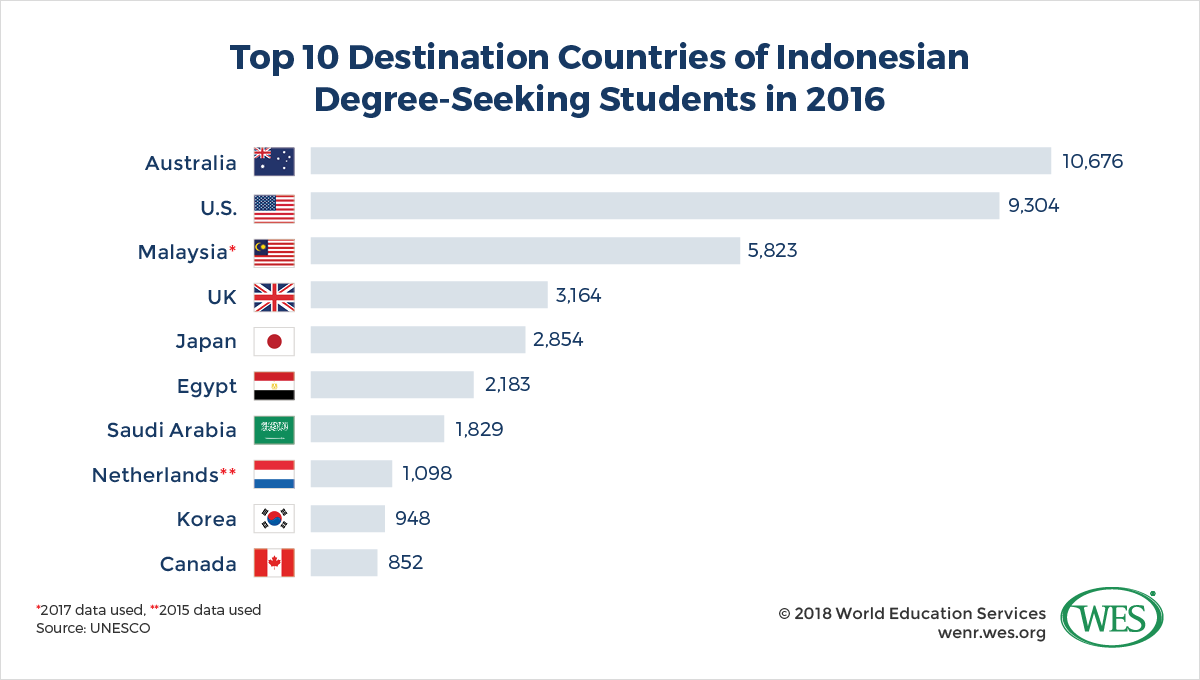
The top 3 destination countries for Indonesian degree-seeking students enrolled overseas are Australia, the U.South., and Malaysia. Together, these three countries make upwardly the written report destinations of nearly 60 percent of all outbound Indonesian students. In Australia, the number of tertiary caste-seeking students as reported by the UIS has remained stable at effectually 10,000 over the past few years. In that location were ten,646 Indonesian degree students in the land in 2016 compared with x,148 in 2004.
That said, when taking into consideration students who are enrolled in vocational programs, secondary education, and English language Language Training programs, the number of Indonesian students has grown past 29.five percent over the past decade, from sixteen,063 in 2008 to 20,797 in 2018, according to Australian authorities data. The country is bonny to Indonesian students because of its "geographic proximity, perceived institutional quality, and English-medium education…." The Australian government's easing of educatee visa requirements for Indonesia and other countries in 2012 has also helped attract students from the archipelago. Indonesia is presently the 10th-largest country of origin of international students in Commonwealth of australia.
However, it remains to be seen how the eagerly awaited opening of Australian branch campuses in Indonesia will affect pupil flows. In 2018, Republic of indonesia legally allowed foreign branch campuses to operate in the country. It signed a free trade understanding with Commonwealth of australia that lays the groundwork for Australian universities similar the Academy of Melbourne and the University of Queensland to institute co-operative campuses in Indonesia. While this trend, if it materializes, is expected to enable larger numbers of Indonesians of more than limited financial ways to enroll in Australian institutions, it may simultaneously stop other students from going to Australia, since they'll be able to admission Australian education in Indonesia.
Other Destination Countries
Similar Commonwealth of australia, Malaysia is a popular pick for mobile Indonesian students because of its geographic proximity. But the country is also attractive because of its cultural, religious, and linguistic similarities to Republic of indonesia. Also, the stiff migrant networks that have adult over decades of large-scale migration may provide a reassuring cultural environment for Indonesian students. Beyond that, Malaysia is a relatively affordable written report destination compared with Western countries, notwithstanding it has a sizable number of foreign branch campuses of reputable Western universities.
While the number of Indonesian students in Malaysia has grown significantly over the past decade, despite fluctuations,4 it'southward of import to annotation that People's republic of china is as well surging in popularity as a study destination and may at present attract more Indonesian students than Malaysia. The fact that there are no UIS statistics bachelor for Prc prevents comparative analysis, merely according to Chinese government information, at that place were 14,000 Indonesians studying in China in 2018 (upward from x,957 in 2011). Annotation that the Chinese data include unlike types of students, whereas UIS data for Malaysia comprise only those students enrolled in formal degree programs.5
Furthermore, there are meaning student movements to Egypt and Kingdom of saudi arabia, the latter beingness a major labor migration destination for Indonesian workers. The migration corridor connecting the two countries is one of the largest in Asia, over which one.5 million Indonesian migrants traversed to Saudi Arabia in 2017. This trend has coincided with a 611 percent increment in Indonesian degree students studying in Kingdom of saudi arabia, from 254 in 2010 to ane,806 in 2017. Arab republic of egypt, on the other hand, draws sizable numbers of Indonesian students each year to its famous Al-Azhar Academy, known as "Sunni Islam's almost prestigious university."
Trends in the U.Southward. and Canada
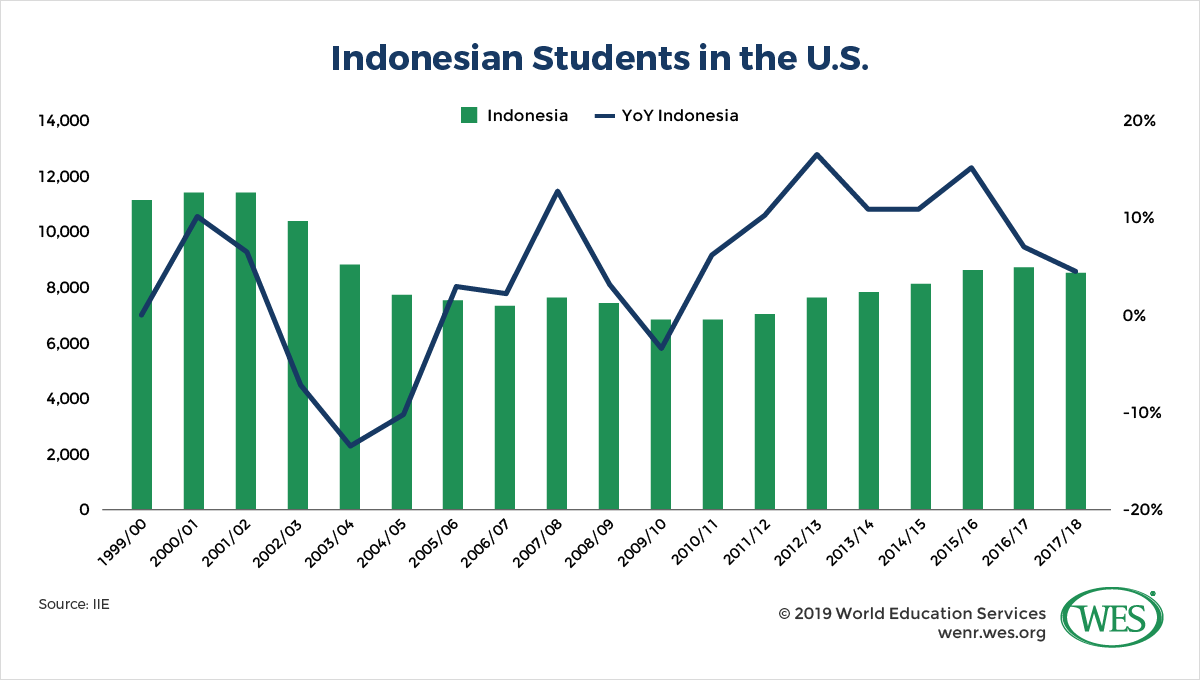
While the U.S. is still the second almost popular destination for mobile Indonesian students, Indonesian enrollments in the U.S. accept dropped significantly in contempo years. They never fully recovered later the 9/11 terror attacks. International student enrollment dropped in the wake of U.S. government-imposed visa restrictions and the globally unpopular 2003 Iraq state of war. According to the Institute of International Education's Open Doors information, the number of Indonesian students decreased from xi,625 in 2000/01 to a low of half dozen,942 in 2010/eleven, earlier increasing modestly once more to eight,776 in 2016/17. Nearly recently, enrollments have declined by some 1 percent to 8,650 in 2017/18, a drop coinciding with the Trump administration's travel ban, which restricts entry to the U.S. for citizens from seven countries—five of which are majority Muslim.
Republic of indonesia is presently the xixth-largest sending country of international students to the U.s.a.. The majority (threescore percent) of Indonesian students pursue undergraduate degrees, while 14 percent enroll at the graduate level, three pct at the non-degree level, and 8 pct participated in OPT. The about popular fields of report are STEM fields (33.1 percent total), followed past business and management (28 percent). Notably, v of the ten most popular institutions among Indonesian students are community colleges, with students at community colleges making up around forty per centum of all Indonesians applying for U.S. student visas.
It's unclear how student inflows from Indonesia will develop in the time to come. In general, the U.Southward. higher pedagogy system is bonny to Indonesian students for several reasons. The previously mentioned AFS survey reflects the loftier importance of English-medium instruction besides as land and establishment reputation in Indonesian students' decisions to study abroad. On the other hand, since the election of Donald Trump as president, the U.S. has become less popular co-ordinate to Indonesian public stance polls. Likewise, increasing tuition costs in the U.S. and the contempo depreciation of the Indonesian rupiah against the U.Southward. dollar make it more than costly for Indonesians to study Stateside. How well the U.S. can compete with Australia, Malaysia, and, virtually recently, China in attracting Indonesian students remains to be seen.
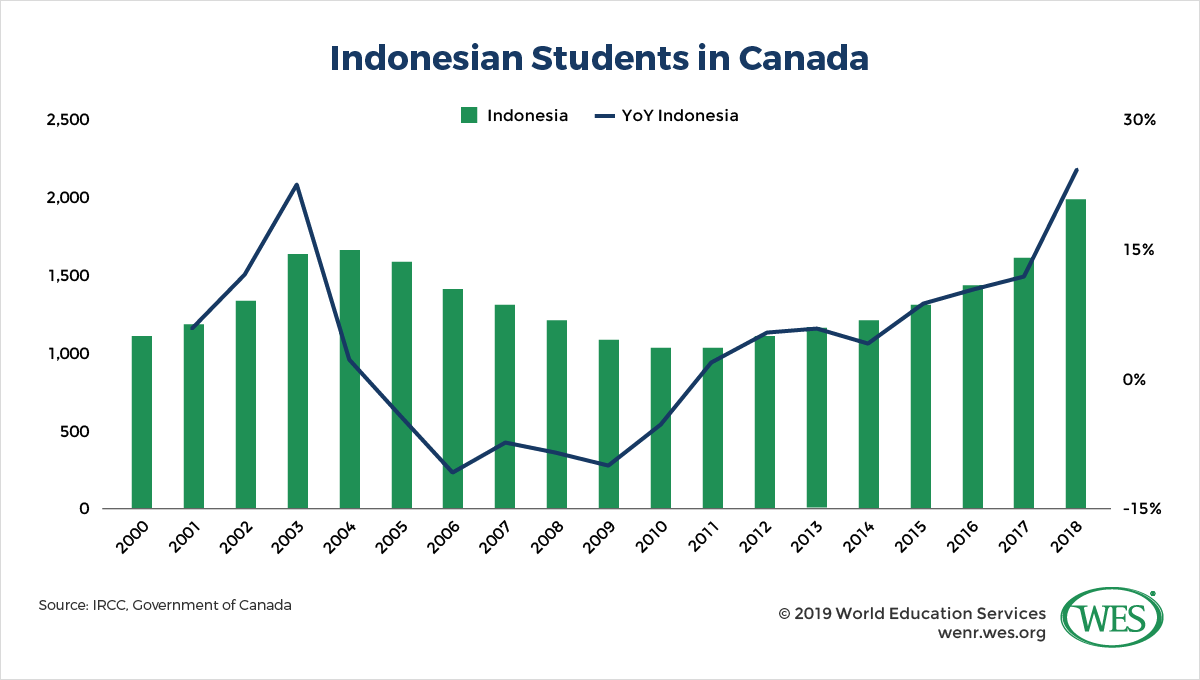
Indonesian pupil enrollments in Canada are insufficiently small and have fluctuated over the past two decades—from 1,655 in 2004, down to 1,015 in 2010, and back up to i,970 in 2018. Recent growth rates have outpaced those in the U.Due south., possibly because of Canada's expansion of post-study work opportunities and clearing pathways for international students. Overall, Republic of indonesia is the 31st-largest sending country of international students to Canada.
Inbound Student Mobility
Republic of indonesia is not a major study destination for international students. The country has the lowest inbound mobility ratio (0.07 per centum) of all ASEAN countries for which data are bachelor.6 Since its college educational activity sector is relatively underdeveloped, information technology doesn't accept institutions of global reputation, nor does it have chapters to provide for its ain domestic pupil population, let solitary foreign students. With many prestigious and highly ranked universities located in other Asian countries nearby, regional students looking for high-quality overseas teaching are unlikely to plow to Indonesia. Equally a result, Indonesia hosted simply 5,878 international degree students in 2017 despite its size. More than than l pct were from neighboring Malaysia (one,500 students) and Timor-Leste (1,302). Thailand, India, and China are other larger sending countries with 804, 674, and 431 students, respectively, in 2017, per the UIS.
In Cursory: The Pedagogy Arrangement of Indonesia
Modern instruction was introduced in Republic of indonesia during the era of Dutch colonial rule, when traditional schoolhouse systems like Islamic boarding schools (Pesantren) were supplemented with Dutch-language schools for the children of colonialists and local administrative elites, as well equally village schools or "folk schools" for Indonesian commoners. The first HEIs were established in the 1920s on Coffee. The system was elitist and accessible only to the select few.
Later independence in 1945, Indonesia constitutionally enshrined education as a correct of all Indonesian citizens and sought to institute a more egalitarian and inclusive mass pedagogy system. Although public teaching is mostly secular and Republic of indonesia is formally a secular state, Islamic instruction is highly prominent in Indonesia's large private education sector. The massive 29 one thousand thousand member-strong Islamic arrangement Muhammadiyah (followers of Muhammad), for example, currently operates 172 universities, some 2,600 uncomplicated schools, and close to 3,000 secondary schools throughout Indonesia. These institutions teach a secular, full general academic curriculum in add-on to religious studies.
While Islamic education was long regarded as 2nd rate, the rise of Islamic conservatism in Indonesia has led to an increase in Islamic education in public school curricula in contempo years. Similar other aspects of public life, teaching is afflicted by the growing Islamization of Indonesian society, which has traditionally favored a more moderate brand of Islam. Nowadays, information technology is not uncommon for Indonesian children to attend pesantrens, madrasahs (Islamic schools), or sekolahs Islam (mod Islamic schools).
In terms of size and telescopic, the education system of the diverse Indonesian archipelago has become much more uniform. It has also grown rapidly since the center of the 20th century: The number of senior secondary schools doubled from 67,000 in 1974 to more than 146,000 in 2011, while the number of HEIs tripled within merely 17 years—from ane,236 in 1995 to 3,815 in 2012. Likewise, the number of elementary students jumped from 14.9 million in 1970 to 29.35 million in 2016, and the number of third students surged from only 248,000 to effectually 9 million over the same time span (UIS data).
Administration of the Education System
While Republic of indonesia is formally a centralized "unitary democracy," it is effectively a quasi-federal country that concedes a considerable caste of autonomy to provinces like Aceh (Sumatra), the upper-case letter region of Jakarta (Coffee), the special region of Yogyakarta (Java), Papua, and West Papua. Overall, there are 34 provinces which are farther subdivided into thousands of districts, subdistricts, cities, and more 75,000 villages.
Under the decades-long dictatorship of President Suharto, who ruled the country from 1967 to 1998, the education system was highly centralized and administered by the Ministry building of Instruction and Culture (MOE) and the Ministry of Religious Affairs in Jakarta, with the latter overseeing religious instruction. Yet, since the end of the Suharto regime and the subsequent democratization of Indonesia, various functions of government take been decentralized and transferred to locally elected district governments. Legislation enacted in the early 2000s not but introduced complimentary and mandatory basic pedagogy and the commitment to spend 20 percent of the national budget on education, merely likewise gave schools throughout Indonesia much greater authoritative autonomy.
That said, the school organization is even so centrally steered by the MOE, which is responsible for curriculum development, the hiring of teachers, and national school examinations. Since 2015, higher education is overseen past a split ministry, the Ministry for Research, Technology and Higher Didactics (MRTH), which supervises both public and individual HEIs and ensures quality control. As discussed in greater detail below, all HEIs are additionally mandated to seek accreditation by the National Accreditation Bureau of College Education (BAN-PT). Religious institutions, meanwhile, are overseen by the powerful Ministry of Religious Affairs. Compared with how the school system is administered, higher instruction is generally more centrally controlled. Virtually HEIs take just very limited autonomy.
Language of Instruction and Academic Calendar
Indonesian is the official linguistic communication of education in the schoolhouse system, although Indonesia'southward various spoken languages may also be used at the local level in the first years of elementary educational activity. In higher didactics, Indonesian is the medium of instruction as well, but English is becoming more common for some programs, and textbooks are commonly printed in English. There have been some plans to make English mandatory at Indonesian universities, merely these plans have not been realized as of today.
The academic year in the schoolhouse systems generally lasts from July to June with a break in Dec and during the Muslim Eid Holiday. The bookish calendar at universities typically runs from Baronial or September to May or June, divided into 2 semesters. Some institutions may have an additional summer semester from June to August.
Simple Education
Education in Indonesia is compulsory and provided complimentary of charge at public schools from grades 1 to 9 (six years of elementary instruction and three years of inferior secondary education). The official historic period of entry is vii, simply many pupils enter at the age of 6. The Indonesian authorities plans to extend compulsory education to grade 12, merely these plans take not yet been implemented due to the associated costs and other reasons.
Prior to elementary education, children can attend not-compulsory preschools offered by private kindergartens and day care centers, as well equally public early childhood education providers. The regime presently prioritizes early didactics and has achieved a sharp increase in the nationwide preschool GER from 50.2 percent in 2010 to 72 percentage in 2014. However, significant disparities persist between the sexes and between urban and rural regions. The simple GER in more remote island groups like Papua, Kalimantan, and Maluku, for instance, remained well below 50 percent in 2014.
Elementary education (pendidikan dasar) lasts for six years (grades one to vi). The curriculum comprises basic subjects like religious education, national philosophy and civics, Indonesian, mathematics, science, social science, arts, and concrete educational activity. Indonesia'southward authorities revised the national school curriculum in 2013 to place greater accent on "moral graphic symbol education" and creative thinking (Kurrikulum 2013). Every bit a outcome, the number of mandatory subjects at the elementary level was reduced and subjects like English language and information technology were removed from the elementary cycle, while the education of scientific discipline was scaled back. However, the nationwide implementation of this new curriculum has been delayed since many schools and teachers are not yet ready for the changes, so that most schools all the same teach the quondam curriculum. One claiming is that curricula and textbooks are designed nationally in Jakarta, but teachers are trained locally in the regions.
The majority of elementary schools—more than 80 per centum in 2010—are public, but private institutions play an important function in Indonesia'southward schoolhouse arrangement, especially at the secondary level: 57 percent of schools at the lower-secondary level and 70 percent at the upper-secondary level were individual in 2010, even though a majority of students were enrolled in public institutions. Religious schools are largely individual. These schools teach the standard national curriculum in addition to religious studies. About 15 percent of all schools in Indonesia were sectarian institutions in 2014; the vast majority (300,000) were Islamic institutions nether MORA, compared with less than ane,000 schools affiliated to other religions like Buddhism, Christianity, or Hinduism. Islamic schools are typically tied to Islamic mass organizations and are eligible for some form of government funding fifty-fifty if they are privately endemic.
International Schools
Indonesia also has the highest number of international schools in Southeast Asia . These prestigious and expensive schools teach strange curricula and are amassed in major cities similar Jakarta. Until recently they were frequented by both the children of expats and wealthy Indonesian elites, but regime directives from 2014 related to the strengthening of the "moral character" of Indonesian youth barred Indonesian nationals from attention wholly foreign-endemic schools, which were renamed "foreign education institutions." Instead, Indonesians can nourish so-called "articulation cooperation schools" which are locally endemic but accredited overseas. These schools are required to incorporate parts of the national curriculum, namely Indonesian culture and language, while withal instruction strange curricula .
Bated from expensive aristocracy schools that teach foreign curricula, however, private schools that teach the national curriculum are by and large considered a substandard choice that is reflected in the performance gaps between public and individual sector students. Learning outcomes, as measured by test results in the OECD PISA study, show that students at public schools are better prepared. Even though student-to-teacher ratios in the private sector are lower than in the public sector, private madrasahs, for example, tend to accept lower-qualified teachers and inadequate facilities. These quality considerations nonetheless, enrollments in private institutions at the elementary level increased from sixteen percent to 22 percent between 2004 and 2017. Enrollments at upper-secondary private schools, on the other hand, decreased from 54 to 46 pct over the same time span, according to UIS data.
Lower-Secondary Education
Lower or inferior secondary educational activity lasts for three years (grades vii to ix) and concludes with the award of the certificate of completion of junior secondary school (sekolah menengah pertama, or SMP). Pupils who complete junior secondary education at religious schools under the purview of the Ministry building of Religious Affairs receive the equivalent document of completion of madrasah tsanawiyah (MTs).
The national curriculum largely includes the same subjects every bit in elementary education, but likewise adds additional scientific discipline classes in biology, chemistry, or physics; social science subjects similar world history; and English. The pedagogy style prioritizes rote memorization; promotion and graduation were, until recently, largely based on external national examinations (ujian nasional, or UN), typically in a multiple-choice format at the finish of each school year. Still, national exams have been deprioritized in contempo years, and since 2015 no longer make up the mandatory cadre assessment benchmark. Now both promotion and graduation are increasingly based on continual assessment and schoolhouse-based examinations, although students continue to sit for the UN.
General Upper-Secondary Education
Students who complete junior secondary pedagogy and earn sufficiently loftier grades can enroll in either general academic senior secondary school (sekolah menengah atas, or SMA), or vocational upper-secondary schools (sekolah menengah kejuruan, or SMK, discussed below). Both full general academic and vocational programs can also be completed at Islamic senior secondary schools, chosen madrasah Aliyah (MA), or in the instance of vocational programs, madrasah aliyah kejuruan (MAK).
While 55 percent of students enrolled in academic programs in 2015, enrollments in the vocational track accept been growing fast in recent years, at annual rates of 12 to 14 pct between 2004 and 2012. Participation in upper-secondary instruction has grown briskly in general with the GER jumping from 69.5 percent to fourscore percent between 2012 and 2017, according to UIS data. That said, this ratio remains far from the regime'southward goal of making senior secondary education universal for all Indonesian youth. There are also notwithstanding significant disparities between regions and districts—GERs in some districts were still as low equally thirty percentage at the beginning of this decade.
Senior secondary education is before long neither compulsory nor costless. It lasts three years (grades ten to 12) and is offered in dissimilar specialization streams in the general academic track. In the final two years of the programme, following a common full general academic core curriculum in grade x, students can specialize in languages (Indonesian, English language, and other foreign languages), sciences (biology, chemical science, and physics), or social sciences (sociology, economy, and geography). Students in religious schools specialize in religious subjects.
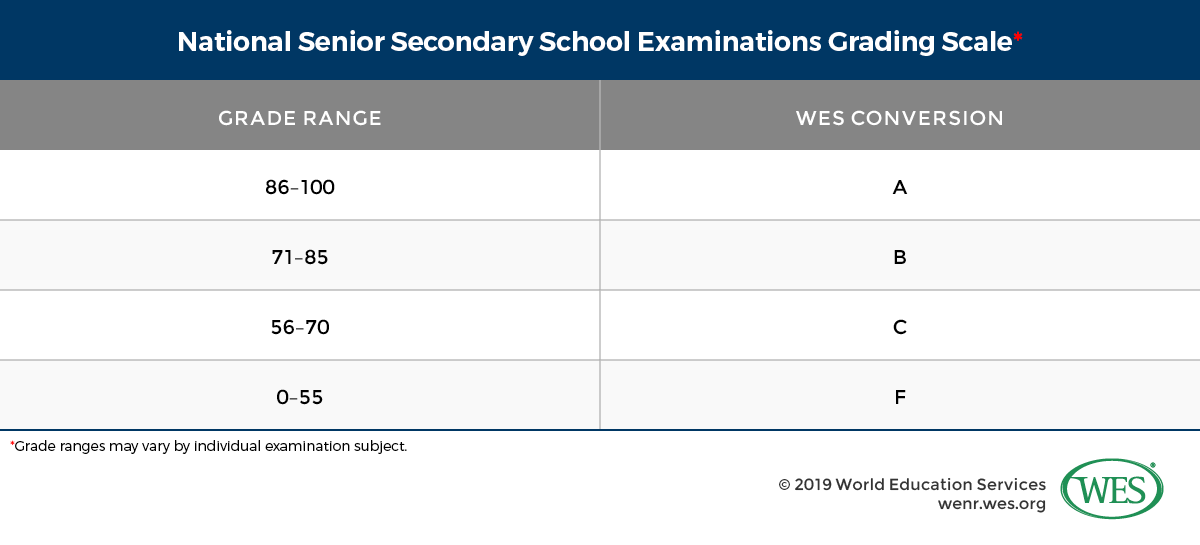
The current curriculum places less accent on rote learning and examinations than previous incarnations, although students however sit down for school examinations, besides as the final external UN examination at the end of form 12. Co-ordinate to the most recent regulations, there are four exam subjects taken in the United nations: Indonesian, English, mathematics, and one elective subject from students' respective specialization streams. Students who successfully consummate the program receive a certificate of completion of senior secondary education (Ijazah SMA or Ijazah MA in the case of Islamic schools). There are too informal pedagogy programs for students who cannot access the formal system or who dropped out. These students don't specialize—they are examined in vii subjects and receive a senior secondary school equivalency certificate (Izajah Paket C Setara SMA).
 Vocational Upper-Secondary Instruction
Technical and vocational education and training (TVET) in Indonesia takes place both within the formal school organization as well as informally in apprenticeships, other work-based preparation programs or grooming programs at governmental vocational and skills grooming centers (Balai Latihan Kerja, or BLK). In the formal organisation, TVET starts at the upper-secondary level and is offered by both secular vocational schools (SMKs) and religious schools (MAKs). There are more than than ten,000 formal vocational secondary schools on the archipelago, mostly clustered on the populous islands of Coffee and Sumatra, about 70 percent of them private.
As mentioned before, more than than 50 percentage of upper-secondary students in Indonesia study in the general academic track, but the authorities is seeking to drastically aggrandize TVET and change enrollment ratios, then that 70 percent of students will written report in the vocational rails past 2020. TVET is prioritized in order to alleviate astringent skilled labor shortages. The authorities projected in 2016 that Republic of indonesia needs three.8 million new skilled workers annually until 2030 to bridge a gap of 56 million skilled workers.
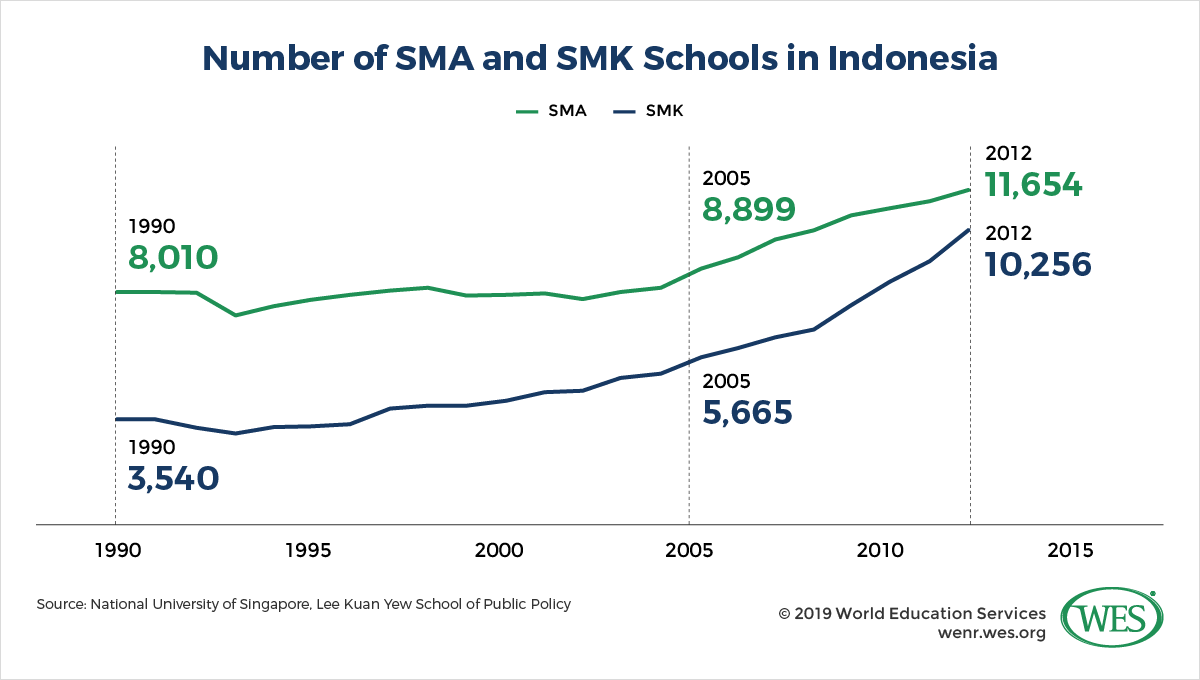
SMK programs are typically three years in duration after course nine, merely there are also iv-year "SMK plus" options. These straddle secondary and mail-secondary education and lead to the award of a ane-twelvemonth mail service-secondary diploma (D1) in addition to a senior secondary school diploma.
Vocational high schools offer more than 140 dissimilar specializations, including fields like agri-business engineering science, allied health, business and management, data and advice technologies, and applied science technology. Notwithstanding, 60 percent of all students enroll in just ten popular disciplines, including bookkeeping, computer applied science, marketing, motor vehicle technology, multimedia, or role assistants. The majority of vocational schools specialize in the fields of technology and industry (86 percent) and business and management (76 pct).
SMK programs cover a general didactics core curriculum (including mathematics, Indonesian, English language, natural sciences, social sciences, and so-called normative subjects like religious educational activity and civics), every bit well every bit vocationally oriented subjects. Some programs may incorporate internships and other practical grooming components. Afterwards completing the plan, students sit down for national examinations in both the general pedagogy subjects and the vocational subjects. Graduates receive the Ijazah SMK and a document of competency in their vocational specialization. It's currently planned that students volition likewise earn a series of formal vocational training certificates during the course of their studies, and then that graduates and school dropouts alike can obtain qualifications of greater value in the labor marketplace.
Higher Education
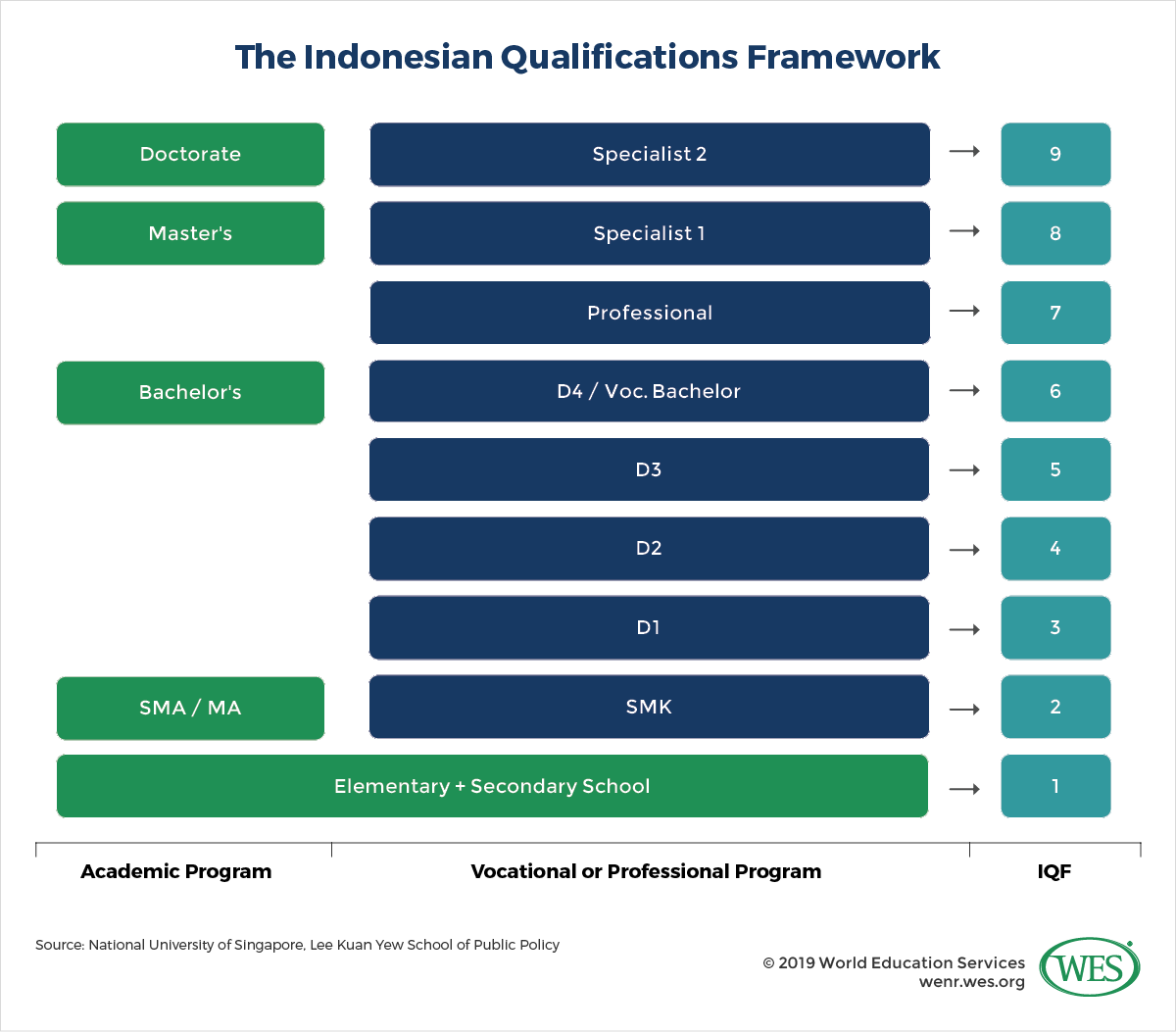
Like its secondary school system, Republic of indonesia's college educational activity system is binary in nature. Information technology has an bookish, inquiry-oriented rails and a more than applied vocational or professional track. The country'southward qualifications framework, established in 2012 to facilitate mobility betwixt bookish programs and the recognition of prior learning, illustrates the dissimilar subsystems and how they are related.
Types of Higher Teaching Institutions
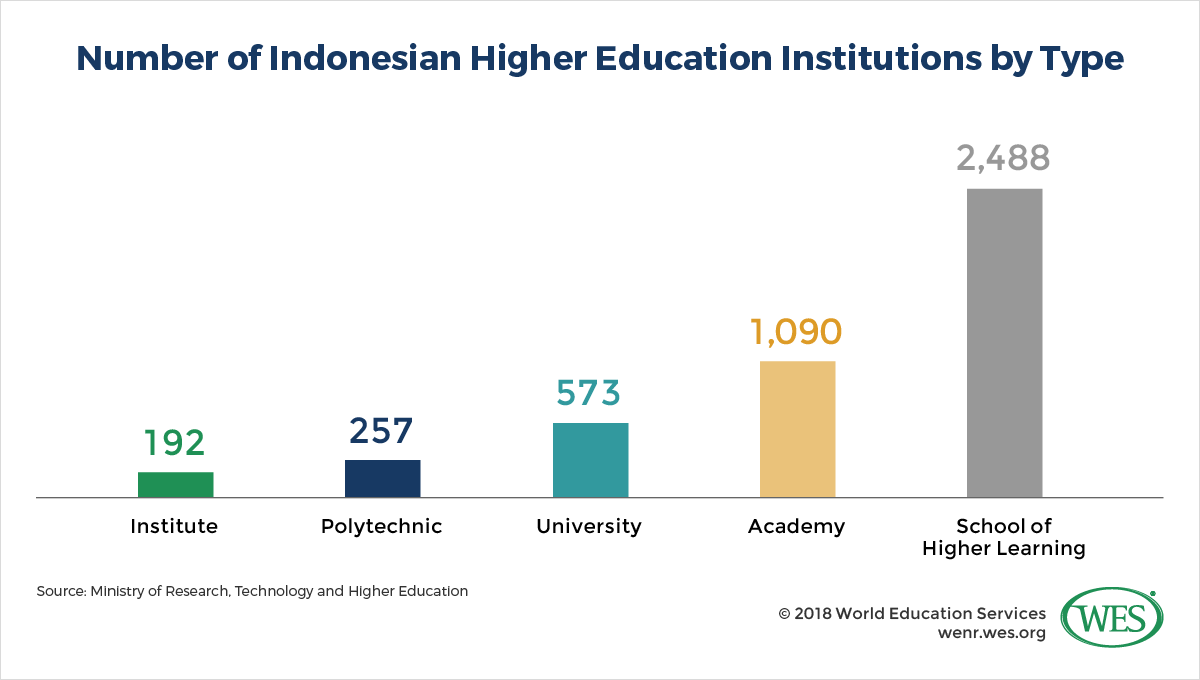
Indonesia has a vast, quickly growing, and highly diverse college didactics mural. Nearly iv,500 HEIs offer programs in 25,000 different majors and enroll close to 8 1000000 students (2017). There are several unlike types of HEIs, including universities, institutes, advanced schools, academies, polytechnics, and customs academies. While enrollments at Islamic institutions are surging, near HEIs in Indonesia are secular. Simply virtually 16 pct of institutions were faith based in 2015, including 11 public universities and 95 individual universities. Together they enrolled approximately 11 per centum of the total student population in 2013.
The vast majority—more than than 90 percent—of HEIs in Indonesia are privately owned. Only while enrollments at individual HEIs are swelling, many private institutions are small providers with 500 students or less, so that public institutions enroll effectually 37 percent of all 3rd students. Public institutions also tend to have a better reputation in Indonesia as well as internationally: All five Indonesian universities included among the top 2,000 in the current Times College Education World Academy Ranking, for example, are public, including the University of Republic of indonesia, Indonesia's oldest public university ranked highest at position 601—800, and the Bandung Institute of Technology (ranked at position 801—i,000).
University (Universitas) and Institutes
According to the MHRT, at that place were 573 universities in Indonesia as of 2018, more than 90 percent of them individual. Many are larger multi-disciplinary institutions that offer a wide range of undergraduate and graduate programs. Universities must take at least three faculties. Few universities offer doctoral programs. But 40,737 students were enrolled in PhD programs throughout Republic of indonesia in 2017. Institutes are specialized university-level HEIs that offer only bookish programs in particular fields.
Advanced School (Sekolah Tinggi) and Polytechnics
Advanced schools or schools of higher learning are the near common course of Indonesian HEI. At that place were 2,308 of these institutions throughout the archipelago in 2018, the majority of them smaller, specialized individual schools. They typically offering undergraduate programs in a particular area of report leading up to a four-year diploma (Diploma VI) or available'south degree, although some institutions also offer graduate programs. Polytechnics, on the other paw, mostly offer shorter, employment-geared, vocational diploma programs. There were only 257 polytechnics in Indonesia in 2018.
Academy and Community Academy (Akademi Komunitas – AK)
Academies are dedicated to vocational education at the undergraduate level and can exist public or private. Community academies were initially set up upwards every bit public institutions specifically designed to prepare students, including adult students, for local employment and to prioritize the labor needs of the regions where they are located. All the same, community academies tin exist privately endemic as well, as long equally they offer depression-price diploma programs in vocational fields of local relevance. The Indonesian government intends to institute a community academy in each district of the state.
Altitude Educational activity in Indonesia
On a dispersed and disparate archipelago like Indonesia, distance instruction is an constructive means to provide didactics in remote areas, even though low computer literacy rates and the lack of electricity and internet infrastructure in parts of the archipelago still limit its growth. For example, Indonesian children who lack access to physical schools tin can complete junior high school in open " radio schools ." In college education, distance education was pioneered by the public Republic of indonesia Open up University (Universitas Terbuka), which evolved from a small fringe university when it was founded in 1984 to a mega-university of more than 500,000 students today . Tasked with providing education to underserved populations in isolated regions, it delivers diploma, bachelor'due south, and master's programs through distance and hybrid learning systems, using media like radio and TV broadcasts, videotapes, and, increasingly, the internet. While the adoption of distance learning in Indonesia is nevertheless pocket-sized, growing numbers of other HEIs have followed the example of the Open University and now offer distance learning programs—a development explicitly encouraged by the government in Jakarta . Overall, the e-learning market in Indonesia has grown past 25 pct betwixt 2010 and 2015. It still has tremendous potential for farther expansion, given that the country is already viewed equally one of the earth'due south largest markets for mobile learning .
Quality Assurance and Accreditation
Educational quality is a pressing concern in Indonesian higher education. Existing shortcomings are amplified past the rapid growth of the system and the mushrooming of low-quality individual providers absorbing the surging need. In 2017, merely 65 institutions (less than 2 percent of all HEIs) obtained the highest level of accreditation in Indonesia, while quality at the remaining institutions varied—some HEIs had no accredited programs at all.
Given the growing quality bug in the individual sector, the MHRT in November 2018 announced that it would revoke the permits of some 1,000 private HEIs and gradually shut and merge these institutions. Mutual quality problems include inadequate management structures, funding, facilities, and teaching materials, as well as lackluster research output. Poorly trained university instructors are another issue of concern. More than a 3rd of Indonesian lecturers hold but a bachelor's caste or less.
To improve quality standards, the Indonesian government in the mid-1990s created a National Board for Higher Education Accreditation (Badan Akreditasi Nasioanal Perguruan Tinggi, or BAN-PT), an independent torso under the MOE. Alongside the requirement that all HEIs have mandatory internal quality assurance centers, external plan accreditation past BAN-PT remains the main tool of quality balls until today, even though the accreditation process has undergone diverse changes.
At first, simply private HEIs were required to have their programs accredited. This procedure allowed top-rated individual institutions to obtain "equal status" (disamakan) with public HEIs, while students in lesser-ranked programs were required to sit for an external state examination in lodge to graduate. However, these distinctions between private and public HEIs accept since been abolished. It'south now mandatory for all HEIs to have their programs accredited.
Accreditation is granted for five-twelvemonth periods and is based on the evaluation of institutional cocky-assessments and on-site inspections by BAN-PT. Minimum quality criteria include adequate infrastructure, funding and direction structures, research output, high-level faculty qualifications, and graduation rates. Based on the evaluation by BAN-PT, programs are grouped into 4 categories: A (very proficient), B (practiced), C (satisfactory), or D (unsatisfactory). Programs rated "D" are unaccredited (tidak terakreditasi). BAN-PT maintains an Indonesian-language database of accredited programs.
In 2015, the regime as well introduced a ranking system that classifies universities into 4 categories: platinum, gold, silver, and chocolate-brown (the everyman category). A academy'due south rank is based on factors like publication output, accreditation rating, and, since 2018, scientific innovation. This new ranking system does non affect recognition status, but is designed to foster competition between institutions. The government seeks to nurture "world-course universities," and to incentivize HEIs to increase research output by rewarding elevation-rated institutions with special funding.
While accreditation is mandatory for all academic programs offered in Indonesia, the rapid growth of the teaching systems makes information technology difficult for BAN-PT assessors to keep upwards. In that location were about 3,000 academic programs slated for evaluation in 2009 alone. In 2013, BAN-PT had an estimated backlog of 20 percent in accreditation decisions, causing the organization to adopt "emergency measures" to "requite institutions temporary accreditation at "C" level (the pass level) without whatsoever accreditation process." Among accredited programs, public institutions tend to achieve far amend results: While 40.half dozen of accredited programs at public HEIs received a rating of "A" in 2013, only six.four percent of programs at individual institutions did.
Educational activity Spending
Public educational activity budgets in Indonesia accept long been neglected. Educational activity spending during the Suharto years was extremely meager, hovering around i per centum of Gdp or less throughout much of the 1990s. Public expenditures have since grown drastically, nearly tripling since the early on 2000s. They now stand up at 20 pct of the overall regime budget, every bit mandated by Indonesian law.
However, overall education spending in Indonesia is still adequately low past regional standards. The state spent 3.6 percent of its GDP on pedagogy in 2015, only marginally more in 2008 when information technology spent 3.5 percent. That's a college percentage than in poorer ASEAN countries similar Cambodia and Myanmar, but significantly below levels in Thailand, Malaysia, or Vietnam, which spent iv.one percent (2013), 4.8 percentage (2016), and 5.65 per centum (2013), respectively, of their GDPs on education.
Spending on tertiary education and research is particularly low with the MHRT receiving only 9 percentage of all teaching allocations in 2018. Since about students are enrolled in fee-charging private institutions, Indonesian households are bearing the brunt of third instruction expenditures. Even public HEIs rely increasingly on tuition fees to secure resources—a tendency that recently caused the Indonesian parliament to meliorate the education law in lodge to limit the per centum of tuition fees in public university budgets to 30 percent. Such measures still, the existing funding structures and high financial burdens on private households tend to perpetuate social inequalities in Indonesia. In 2010, only 2.five percent of the poorest quintile of the Indonesian population was enrolled in bachelor's programs compared with 65 percent from the wealthiest quintile.
Admission into Higher Education
Admissions criteria at Indonesian HEIs vary by establishment, but the minimum entry requirement is the senior secondary schoolhouse certificate (Ijazah SMA, MA or SMK). Public institutions are mostly highly selective. While institutions acknowledge a number of top students directly based on their loftier school records (an admissions procedure called Seleksi Nasional Masuk Perguruan Tinggi Negeri—SNMPTN), a more mutual pathway is the allocation of students to HEIs based on a centralized, joint entrance examination conducted under the purview of the MHRT—a procedure referred to as Seleksi Bersama Masuk Perguruan Tinggi Negeri (SBMPTN). The admissions test includes general subjects (mathematics, Indonesian, English), as well as subjects related to the intended area of concentration (for example, science subjects for Stalk fields). The MHRT recently appear that the test will be given entirely in reckoner format showtime in 2019.
In 2018, about 30 percent of seats at 85 state universities were assigned directly to 110,946 students via national SNMPTN selection, while the remaining 70 percent had to sit for archway examinations. Admission is usually highly competitive. Out of 797,738 loftier school graduates who sat for the SBMPTN exams in 2017, only 148,066 students, or slightly more than 14 percent were admitted. The admissions rate in SNMPTN direct admissions stood at nineteen percent in 2018. Private universities, polytechnics, and academies have different requirements and oft acquit their own admissions examinations. Requirements at well-nigh private institutions are typically less strenuous than at public HEIs.
The Higher Education Degree Structure
Republic of indonesia'due south higher teaching degree structure is defined in a logical numerical hierarchy. It includes credentials called Sarjana at the undergraduate level (Sarjana Strata one – S1), graduate level (Sarjana Strata Dua – S2, ordinarily chosen Magister), and doctoral level (Sarjana Strata 3 – S3, commonly called Doktor). In improver, in that location are graduate-level specialization programs (Specialis 1 and Specialis 2) in professional person disciplines like medicine, also as four levels of vocationally oriented diploma programs (DI to DIV).
Undergraduate Degree (Sarjana 1)
S1 undergraduate programs in standard bookish disciplines usually last four years (viii semesters) after upper-secondary school. They typically crave the completion of 144 to 150 credit units of course work and a thesis. Curricula are mostly specialized apart from some mandatory general education subjects, such as faith, national history, and Pancasila (Indonesian state philosophy). Credentials awarded include Sarjana Sains (degree in science), Sarjana Ilmu Sosial (caste in social sciences), or Sarjana Ilma Komputer (degree in computer science), and so on.
Magister (Sarjana 2)
S2 Magister programs are relatively new in Indonesia and were not established on a larger scale until the beginning of the 1990s, initially only at public institutions. They are typically ii years (iv semesters) in length and involve 36 to 50 credit units, as well equally the training of a thesis or completion of a graduation projection. Access usually requires an S1 degree in a related discipline with a minimum GPA of 2.5 (on a 4-point calibration), but archway examinations and demonstrated English language abilities may also be required. Some S2 programs are taught in English. Credentials awarded include the Magister Sains, (Primary of Science), Magister Teknik (Master of Technology), or Magister Humaniora (Primary of Humanities), and so on.
Doktor (Sarjana 3)
The Doktor is a research qualification that represents the highest academic credential in the Indonesian organisation. Programs are a minimum of three years, but commonly take longer to consummate. Curricula typically include some course work at the onset of the plan, a comprehensive test, and the preparation and defence of a dissertation. Entry is based on an S2 degree with high grades, only top students may as well be allowed to enter on the basis of an S1 undergraduate caste, in which example they may accept to complete additional form work.
Diploma Programs (Diploma 1 to Diploma 4)
Diploma programs are offered in vocational fields at a diverseness of institutions. These employment-geared programs can take from 1 year (D1) to four years of written report (D4) to complete; the numbers 1 to 4 stand for to both the level of complexity and the nominal length of written report (although programs may also be completed in more than or less fourth dimension). The D4 is pegged at the same level as the S1 Sarjana in the Indonesian qualifications framework. Credentials awarded at this level may sometimes also be called Sarjana Sains Terapan (degree in engineering). Students may transfer from Diploma programs into bookish Sarjana programs and at some institutions may exist admitted into S2 Magister programs in related disciplines.
Medical Education
Professional person entry-to-practice qualifications in disciplines like architecture, medicine, dentistry, or veterinarian medicine are usually earned by completing long undergraduate programs of v- or six-years duration. Given the rapid modernization of the country, the need for trained professionals in Indonesia has grown tremendously in recent years. The number of medical schools, for example, surged from 27 in 1990 to 83 in 2016. Medical schools are university faculties, close to two-thirds of which are office of private universities. They presently graduate some 8,000 students annually.
The national medical curriculum includes an initial three.v-twelvemonth period of pre-clinical studies, followed by a two-yr clinical stage and a mandatory one-year clinical internship after graduation. The final credential is chosen Dokter (Dr. of Medicine). At that place's also a degree called Sarjana Kedoktoren earned after iv or five years, just this credential does not qualify physicians to practice every bit such without additional study. Institutions like the University of Indonesia offer medical training programs in which students earn a Sarjana subsequently viii semesters and the Dokter after another four semesters of clinical studies. Preparation in medical specialties takes another three to five years, depending on the specialty, and concludes with the award of a Spesialis diploma. In addition, in that location are Spesialis 2 programs for additional in-depth training in subspecialties. Study and training programs in disciplines like dentistry and veterinary medicine are organized similarly.
Teacher Education
Until the mid-2000s, Indonesia's teachers were able to practise with simply a diploma in education. Elementary school teachers required either a Diploma 2 or Diploma 3 kependidikan (education), whereas lower-secondary and upper-secondary school teachers needed at to the lowest degree a Diploma iii. In practice, many simple teachers held only a secondary schoolhouse credential. Just 200,000 out of i.25 million Indonesian unproblematic schoolhouse teachers held a university degree in 2006, while the majority of them had a senior secondary school diploma or a Diploma 2.
Still, legislation from 2005 fabricated information technology mandatory for teachers to accept a iv-year university degree (Sarjana Pendidikan ) or a Diploma four in education order to authorize for public professional teacher allowances. As a consequence, the number of school teachers at all levels of schoolhouse pedagogy holding a Sarjana shot upwardly from 37 per centum in 2003 to 90 percent in 2016. In order to get civil retainer teachers at public schools, candidates must now also fulfill more stringent certification requirements, including a gear up amount of instruction experience and passing scores on qualifying examinations. Existing teachers were required to seek re-certification under the new requirements.
The success rate in upgrading teachers' qualifications was greater in the school system than in higher education. Electric current legislation mandates that all Indonesian academy instructors hold a main's degree. Nevertheless, about 30 percentage of lecturers, especially at individual institutions, still don't meet this requirement. Less than 12 percentage of professors hold a PhD, well-nigh who do teach at peak public universities.
College Instruction Grading Scale
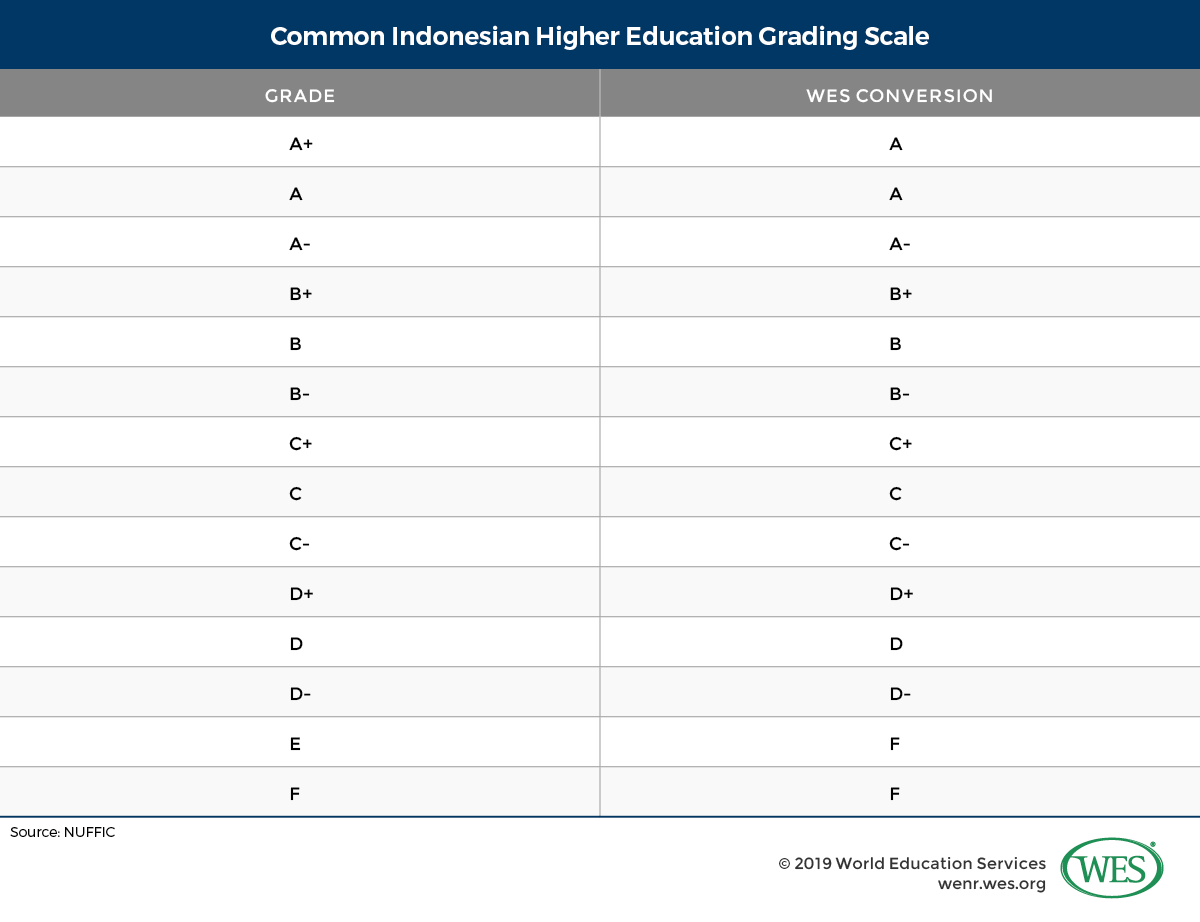
Indonesian HEIs use a number of unlike grading scales, most of which are variations of the U.S.-style A to B scale, either with or without "+" and "-" designations. Some HEIs may use half-bespeak scales with grades similar AB, BC, or CD. A common grading calibration variation is shown below.
WES Documentation Requirements
Secondary Education
- Graduation diploma (Ijazah SMA, SMK, so on)—sent directly by the establishment attended
Higher Education
- Photocopy of the degree certificate (Diploma, Sarjana, Magister, Doktor)—submitted by the bidder
- Academic Transcript—sent directly by the institution attended
- For completed doctoral programs, an official letter confirming the conferral of the degree—sent directly past the establishment
Annotation : Precise, word-for-word English language translations are required for all academic documents not issued in English (or in French if applying in Canada).
For more than data, visit the WES website.
Sample Documents
Click here for a PDF file of the academic documents referred to below.
- Ijazah Sekolah Memnegah Atas (SMA)
- Diploma i
- Sarjana 1
- Sarjana Kedoktoren
- Dokter
- Magister Manajemen (Chief of Direction)
- Doktor
1. The Earth Bank defines people that are functionally illiterate as non "equipped with the skills necessary to enter successfully into the labor marketplace. Students that receive a PISA score of level ane are considered functionally illiterate as they can, for example, read a text but cannot answer questions related to it."
2. Calculation based on the sum of Population anile 14 years or younger and Population aged 15-24 years from 2017 UIS data.
3. Defined as individuals who have an annual net income above USD$3,600 "in purchasing power parity… at 2005 exchange rates."
iv. The number of degree-seeking students reported by UIS increased from 5,704 in 2007 to eight,038 in 2016, before leveling off to 5,823 students in 2017.
v. When comparing international student numbers, it is important to note that numbers provided past dissimilar agencies and governments vary because of differences in data capture methodology, definitions of "international educatee," and types of mobility captured (credit, caste, etc.). The data of the UNESCO Institute Statistics provide the most reliable bespeak of reference for comparing since information technology is compiled according to one standard method. It should be pointed out, however, that it simply includes students enrolled in third degree programs. It does not include students on shorter report abroad exchanges, or those enrolled at the secondary level or in brusk-term language training programs, for case.
6. These are Singapore (27.2 percent), Malaysia (8 percent), Brunei Darussalam (3.eight percent), Thailand (1.3 percentage), Laos (0.four percent), and Vietnam (0.24 percent).
Source: https://wenr.wes.org/2019/03/education-in-indonesia-2
0 Response to "35 Percent Increase in Both Arts and Sciences and Seas Student Enrollment Over the Past Decade"
Post a Comment