Mac Mount Remote Server for Read and Write
Introduction
SSHFS (SSH File System) is a client for mounting a file organisation located on a remote machine onto your local organization through an SSH connection. Using the SFTP (SSH file transfer protocol), the SSHFS command-line tool mounts a physical or virtual deejay locally, allowing file transfer between a local and remote automobile.
This article demonstrates the installation and usage of SSHFS to mount a remote folder or file system over SSH.
Prerequisites
- Access to the command line with administrator privileges.
- A remote folder or file system to mount for transferring files.
- The username and host accost of the remote server.
What is SSHFS?
SSHFS is a control-line tool for safely mounting a remote folder from a server to a local machine. The customer extends the SSH file transfer protocol, which helps locally mountain a remote file organization equally a disk image securely.
SSHFS allows accessing, transferring, and manipulating files every bit if working on a local disk. This approach is handy when moving a lot of content to and from a remote machine.
SSH offers two ways to establish a connection:
one. Using password authentication.
ii. Using the SSH primal pair (recommended).
For Linux and macOS, the best fashion to mountain a remote directory is through the terminal. On the other mitt, Windows offers several solutions, including the command line, Windows Explorer, and a GUI.
Install SSHFS
SSHFS is non available by default on most machines. Different packages exist based on the operating system of the local machine.
Linux
To install SSHFS on Ubuntu/Debian systems using the apt packet manager, run:
sudo apt install sshfs For CentOS based systems, install SSHFS using the yum package director:
sudo yum install fuse-sshfs macOS
To install SSHFS on MacOS, download the latest stable release of FUSE and SSHFS packages. Run the FUSE installer first (dmg file) and the SSHFS (pkg file) second.
Windows
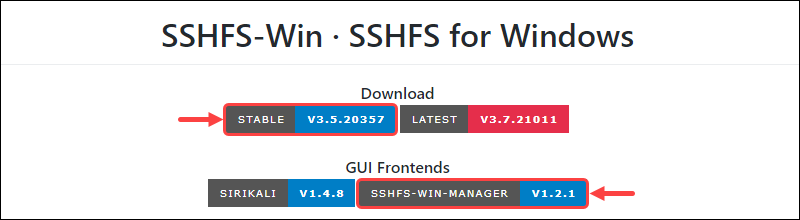
To apply SSHFS on Windows, download and install:
- The latest stable version of WinFS.
- The newest stable version of SSHFS-Win is uniform with your system. Optionally, the SSHFS-Win Manager frontend interface is available also. The interface provides a convenient GUI interface for establishing and managing connections.
Mount a Remote File Arrangement on Linux
Mounting and unmounting a remote file organisation with SSHFS is a simple process. The outlined steps also work on a macOS machine.
Stride 1: Create Mount Bespeak
Create a mount point directory in the mnt binder where the remote file system will be mounted:
sudo mkdir /mnt/<folder name> Step two: Mount the Remote File System Using SSHFS
Mount the remote file arrangement to the created mount indicate using the SSHFS tool:
sudo sshfs [-o <options>] <remote user>@<remote host>:/<path to remote directory> /mnt/<folder proper noun>/ Enter the login password when requested if using password authentication. If the remote server uses SSH fundamental authorization, provide the path of the private primal. For case:
sudo sshfs -o allow_other,IdentityFile=/dwelling/kb/.ssh/id_rsa [email protected]:/home/ubuntu/ /mnt/test/ 
The above control mounts a remote directory located at 131.153.142.254 under the name ubuntu to the /mnt/test/ mount point.
The -o tag indicates the presence of added options:
- The
allow_otheroption allows admission to users other than root. - The
IdentityFile=<path to individual primal>pick is for file systems with configured access via SSH. If the private key is under the root user, the command accepts a relative path. Otherwise, use the full link.
For a comprehensive list of bachelor options, run:
sshfs -h Step three: Bank check Mounted File System
Check if the file system mapped correctly by navigating to the directory using the cd command:
cd /mnt/<directory proper noun> 
Alternatively, navigate to the folder using the GUI:

Step 4: Unmount a Remote File System on Linux
Lastly, when finished with the mount indicate, unmount the remote file system with:
sudo umount /mnt/<binder proper noun> 
Notation: Yet mounted? Double-check if you typed the umount control correctly. There is no letter N.
Mount a Remote File System on Windows via Windows Explorer
The most common way to mount a remote file system on Windows is through Windows Explorer.
Step one: Map Network Drive
Open the file explorer. Right-click This PC from the menu on the left pane and select the choice Map Network Drive.
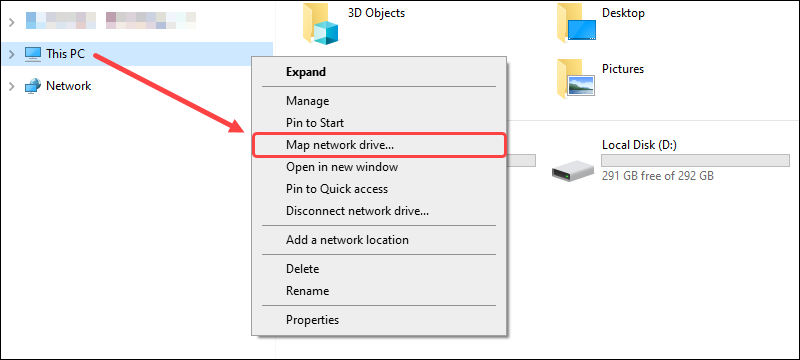
A dialog box appears for network mapping.
Footstep 2: Mount the Remote File Organization Using SSHFS
Select the letter of the drive to which yous'd like to map the remote folder. In the Folder box, type in the sshfs command:
\\sshfs[.option]\<remote user>@<remote host>[!port][\path] Note: The default port for SSH connections is 22. Hackers are aware of this, also. Change the default port if transferring sensitive data.
Depending on your use case, the sshfs command offers a few options:
-
sshfsmaps the remote user's home directory. -
sshfs.rconnects to the remote user's root directory. -
sshfs.kmaps the remote user'south home directory and uses the SSH key stored in <local user>/.ssh/id_rsa. -
sshfs.kradds the remote user'south root directory and uses the locally stored SSH central.
For example:
\\sshfs.one thousand\[email protected] 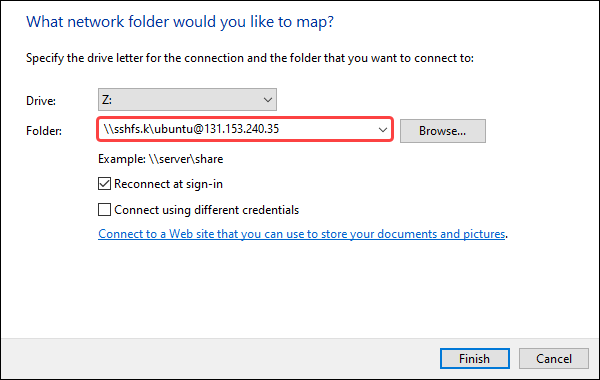
Click End to map the remote file system. A dialog box appears when attempting to make a connection. Upon successfully connecting, the remote file system opens in the Windows Explorer.
Step three: Check Mounted File System
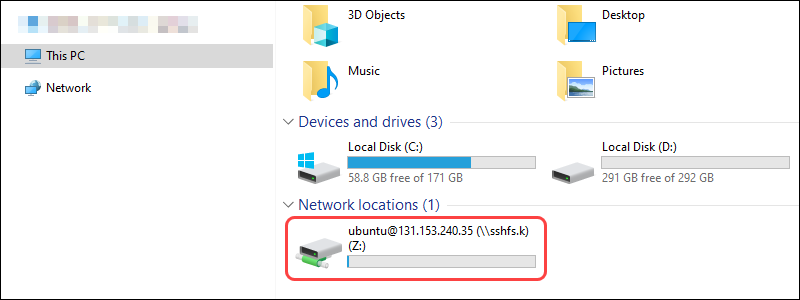
The newly mounted file system is visible from This PC in Windows Explorer under Network locations:
Step 4: Unmount a Remote File System on Windows via Explorer
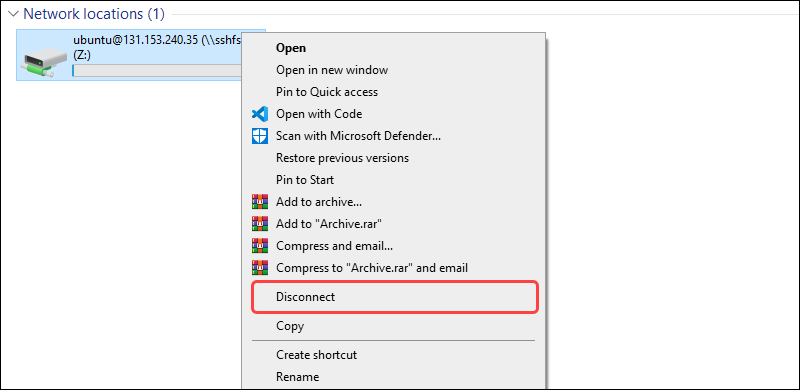
To unmount the disk, right-click the mounted device and select the option Disconnect:
Mount a Remote File Arrangement on Windows via CMD
Mounting a remote file system in Windows via the command line is a quick and uncomplicated procedure.
Pace 1: Mount the Remote File Organisation With net apply
Use the net employ command to mount the remote file arrangement:
net apply <drive letter of the alphabet>: \\sshfs[.option]\<remote user>@<remote host>[!port][\path] For example:
cyberspace use X: \\sshfs.thou\[email protected] The command does the following:
-
Ten:represents the bulldoze letter on the local auto. -
sshfs.kindicates the apply of an SSH key stored in <local user>/.ssh/id_rsa. -
[electronic mail protected]is the remote user and host.

The output of the command informs of a successful connection.
Step 2: View the Mounted Device(s)
To view the currently mounted disks through SSHFS, run:
net employ 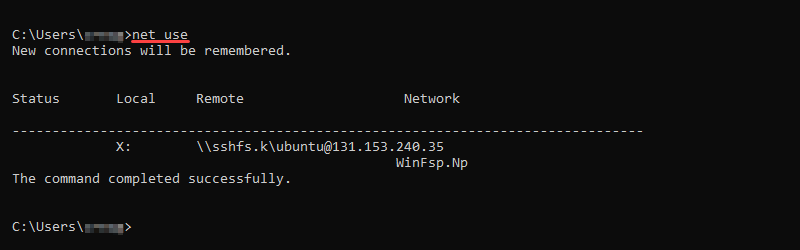
The command outputs the local mount point name and the remote connectedness betoken.
Step 3: Unmount a Remote File Arrangement on Windows via CMD
To remove the mapped device from your organisation, run:
net use <drive letter>: /delete For example, if the remote file system is on the drive X, apply:
net use Ten: /delete 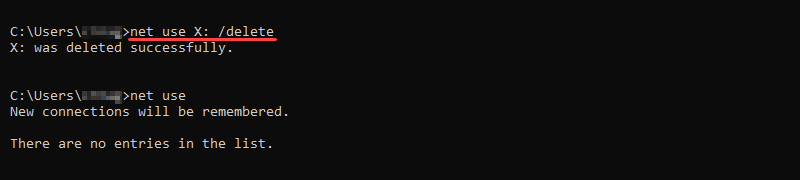
Mount a Remote File System on Windows via SSHFS-Win Managing director
The SSHFS-Win Manager offers a user-friendly and easy-to-apply GUI for establishing and managing remote server connections.
Stride ane: Locate and Run the SSHFS-Win Manager
Search for SSHFS-Win Manager in the Kickoff menu and run the program. A GUI interface opens for managing device connections.
Step 2: Add a Connectedness
Add a new connection by clicking the Add together Connexion button on the right menu.
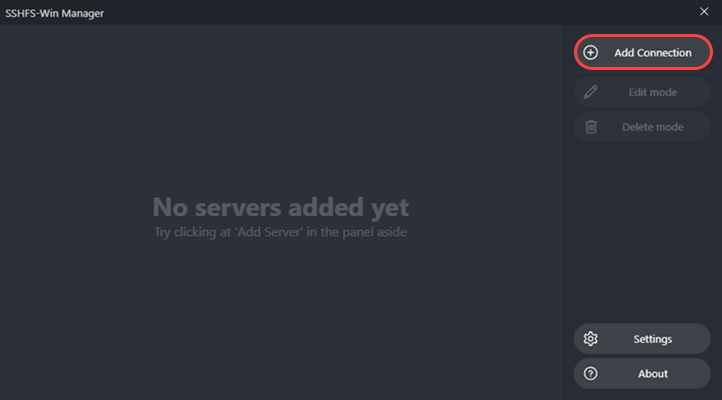
A form bill of fare pops out. Fill out the provided fields and select the options for your situation:
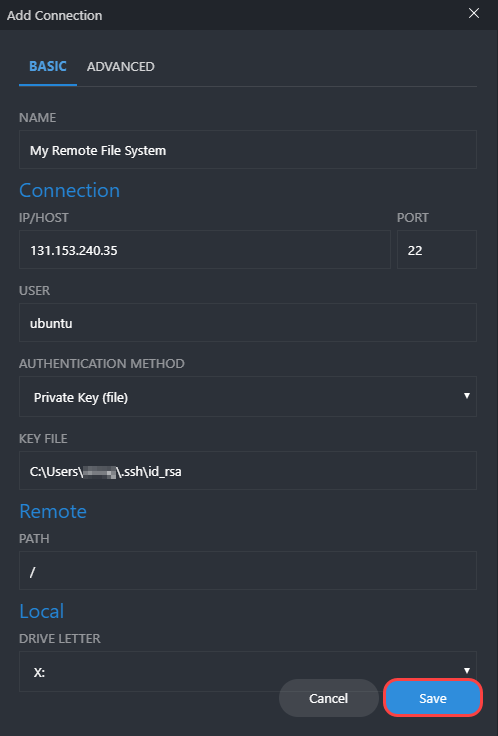
- Name is a custom proper name for your connectedness.
- IP/Host is the host address.
- Port is 22 by default for SSH connections. Leave as-is unless you specifically inverse the port.
- The User is the username of the remote organization.
- The Authentication method is either through a private fundamental file or password. If using the hush-hush fundamental file, provide the path. Alternatively, the password option allows providing a password immediately or when establishing a connection.
- The Remote path is the path to the remote file system.
- Local Drive alphabetic character is a list of locally bachelor bulldoze messages for a mount bespeak.
Lastly, Click Save when done filling out the fields. The newly created server connection shows up in the main menu.
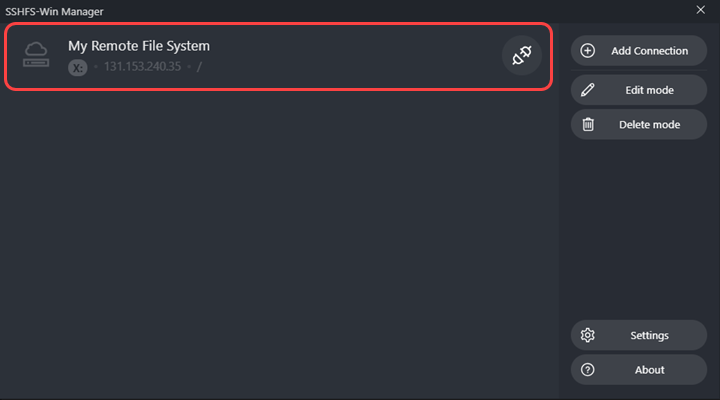
Stride iii: Mountain the Remote File System and View the Contents
Click the socket icon next to your connection proper name to establish a connectedness. If the connexion succeeds, the socket icon changes to a green connected socket, and a binder icon appears:
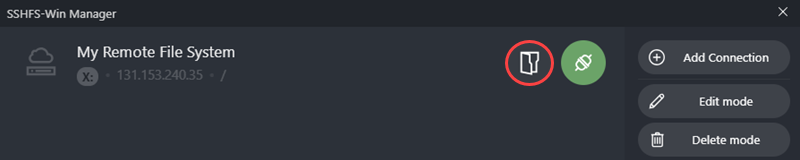
Click the folder icon to view the contents of the remote file system.
Step four: Unmount a Remote File Organization on Windows via SSHFS Win-Director
To unmount the server connexion, click the socket icon in the SSHFS Win-Director bill of fare. If the connection is no longer needed, delete the information using the Delete mode push.
Conclusion
SSHFS provides a secure way to mountain a remote folder to a local machine. The connexion uses the SSH file transfer protocol for each transferred file, ensuring secure communication betwixt ii points.
An alternative way to transfer files via SSH is through remote sync. Bank check out our guide: How to Transfer Files with Rsync and see which method works best for you.
Was this article helpful?
Yes No
Source: https://phoenixnap.com/kb/sshfs
0 Response to "Mac Mount Remote Server for Read and Write"
Post a Comment